Market Snapshot
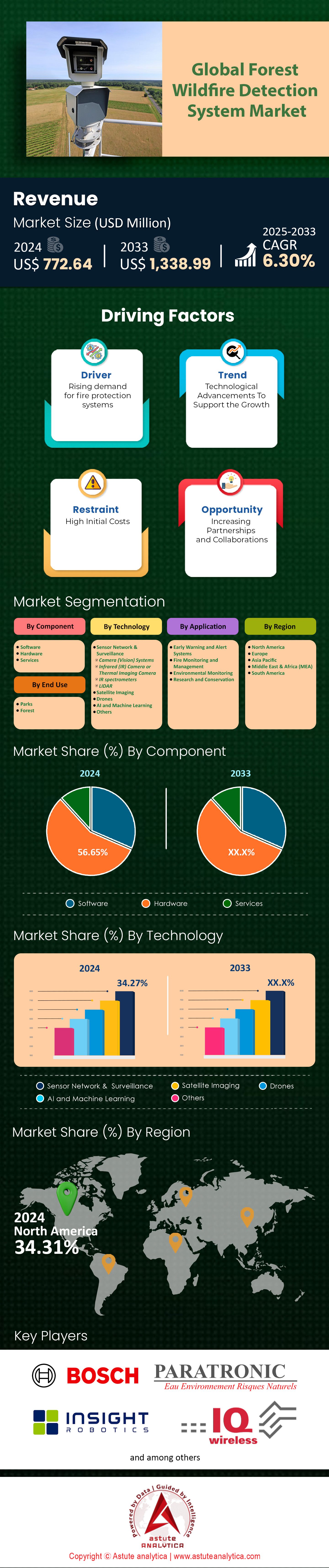
Forest Wildfire Detection System Market was valued at US$ 772.64 million in 2024 and is projected to surpass the market valuation of US$ 1,338.99 million by 2033 at a CAGR of 6.30% during the forecast period 2025–2033.
Key Findings
- Based on technology, satellite imaging stands will continue its reign in the market, accounting for more than 34.2% of its revenue.
- By Component, hardware segment emerges as a critical player, anticipated to generate more than 56.6% of the global forest wildfire detection system market's revenue.
- Based on end use, the segment is mainly bifurcated into forest and parks. Wherein, the forest segment with more than 62.2% revenue contribution is leading the market.
- By application, early warning and alert systems segment accounting for the largest 45.38% market share in the market.
- North America to remain the prominent region in the global market with over 34% market share.
A substantial and accelerating increase in the need for sophisticated monitoring technologies is currently shaping the Forest wildfire detection system market. Primarily, this is a direct response to the growing global threat of wildfires, with an estimated 400 million hectares of forest being affected annually. Consequently, governments are taking decisive action, as evidenced by the U.S. government's 2025 budget, which allocates a significant US$ 1.6 billion to wildland fire management. A financial commitment of this scale is a clear and powerful indicator of the rising demand for effective and reliable solutions.
Furthermore, the market is being driven by the tangible and proven benefits of early detection. For instance, the cost of fighting a wildfire detected within the first hour is merely a fraction of the cost when it is detected after six hours. Impressively, technological advancements are making these systems more accessible and effective than ever before. The number of satellites used for wildfire detection is set to reach 150 by 2025, and advanced AI algorithms can now process vast amounts of data in mere seconds. The integration of IoT is also dramatically expanding the reach of these systems, with over 1 million sensors expected to be deployed in forests by 2025.
The private sector is also playing a significant role in fueling this growing demand across the forest wildfire detection system market. For example, insurance companies are projected to save a remarkable US$ 5 billion in claims in 2025 due to early wildfire detection, and they are even beginning to offer premium discounts to homeowners who install detection systems. Similarly, the timber and agriculture industries are also investing heavily in these technologies to protect their valuable assets. The growth of the market is therefore a multi-faceted phenomenon, driven by a powerful combination of environmental, economic, and social factors.
To Get more Insights, Request A Free Sample
Competitive Landscape Insights Shaping The Forest Wildfire Detection System Market
- Insight Robotics strategically deployed 500 new AI-powered thermal imaging cameras for wildfire detection across North America.
- In 2025, OroraTech's proprietary satellite constellation will expand to include 10 dedicated wildfire detection satellites.
- Dryad Networks plans an ambitious deployment of 120,000 of their solar-powered gas sensors in European forests by the end of 2025.
- Pano AI in 2024 successfully secured contracts with 15 new utility companies in the United States to monitor their infrastructure against wildfire threats.
- Technosylva, in 2024, integrated its cutting-edge wildfire simulation software with the systems of 25 new fire agencies globally.
- Gridware, a promising startup, will install 5,000 of its grid-monitoring sensors in 2025 to prevent utility-ignited wildfires in California.
- EnviroVision Solutions in 2024 upgraded the software for 1,000 of its existing clients to include enhanced AI-driven detection algorithms.
Two significant Trends Creating New and Exciting Market Opportunities in Forest Wildfire Detection System Market
i. Integration of Predictive Analytics and AI-Powered Risk Assessment: The future of wildfire detection undoubtedly lies in the ability to accurately predict where and when fires are likely to occur. By integrating advanced AI and machine learning algorithms with historical fire data, current weather patterns, and real-time sensor data, companies can develop sophisticated risk assessment models. These models can provide fire agencies with a proactive approach to wildfire management, allowing them to pre-position resources and take preventative measures. Consequently, there is a growing demand for platforms that can provide dynamic, real-time risk maps that can be used to make informed decisions about resource allocation and evacuation planning.
ii. Development of Community-Centric and Affordable Detection Solutions: While large-scale, government-funded detection systems are essential, there is a growing and unmet need for more affordable and accessible solutions for smaller communities and private landowners. The development of low-cost, easy-to-deploy sensors and camera networks, combined with user-friendly mobile applications, can empower local communities to take a more active role in their own protection in the forest wildfire detection system market. As a result, there is a significant market opportunity for companies that can provide subscription-based services that include not only the hardware but also the monitoring and alert services. These community-centric solutions can effectively complement larger, regional systems and create a more comprehensive and resilient wildfire detection network.
Key Aspects Defining Demand in the Forest Wildfire Detection System Market
The Transformative Role of AI and Machine Learning in Wildfire Detection
The integration of Artificial Intelligence (AI) and Machine Learning (ML) is a defining aspect of the current demand in the market. These technologies are no longer a futuristic concept; they are now a critical and indispensable component of modern detection systems. AI algorithms can analyze vast amounts of data from satellites, drones, and ground sensors in real-time, identifying complex patterns and anomalies that would be impossible for humans to detect. Consequently, this capability is leading to a significant improvement in the accuracy and speed of wildfire detection. For instance, by 2025, it is expected that 75% of all new wildfire detection systems will have an integrated AI component.
The impact of AI is also being profoundly felt in the reduction of false alarms, which has long been a major challenge for traditional detection systems in the forest wildfire detection system market. By training AI models on vast datasets, it is possible to create systems that can distinguish between a genuine threat and a false positive with remarkable accuracy. In fact, the use of AI has already led to a 35% reduction in false alarms in 2024. This not only improves the system's reliability but also ensures that valuable firefighting resources are not wasted. The growing adoption of AI and ML, with global investment projected to reach US$ 500 million in 2025, is a clear indication of their transformative potential in the Forest wildfire detection system market.
The Expanding Role of Satellite Technology in Global Wildfire Monitoring
Satellite technology represents another key aspect currently defining demand in the Forest wildfire detection system market. Satellites provide a unique and invaluable vantage point for monitoring large and remote forest areas that would be nearly impossible to cover with ground-based systems. Recent advancements in satellite technology, particularly in thermal imaging and high-resolution cameras, have significantly enhanced their capabilities for wildfire detection. Modern satellites can now detect heat signatures from very small fires, and with the number of active satellites used for detection set to reach 200 by the end of 2025, the frequency of global coverage is improving dramatically.
Furthermore, the development of dedicated satellite constellations for wildfire detection, such as the one being built by OroraTech, marks a major step forward. These constellations will provide near real-time monitoring of the entire planet, enabling a much faster response to wildfires. The integration of satellite data with other data sources, like weather patterns, is also creating more comprehensive and accurate wildfire risk models. In fact, by 2025, satellite data will be used to generate wildfire risk maps for 100 million hectares of forest. The growing reliance on satellite technology is a clear indication of its critical importance in the Forest wildfire detection system market.
Segmental Analysis
Satellite Imaging Ascends as the Unblinking Eye in the Sky
Asserting its market leadership with over 34.2% of revenue, satellite imaging continues its reign in the forest wildfire detection system market, propelled by significant public and private investment in next-generation satellite constellations. For example, the U.S. government leverages its GOES-R series satellites for rapid detection, supported by a US$ 20 million investment from the Bipartisan Infrastructure Law to improve speed and accuracy. In 2025, OroraTech plans to launch eight new satellites, establishing the first dedicated constellation for wildfire tracking. Similarly, the Canadian government assigned a Can$72 million contract to Spire Global and OroraTech for its WildFireSat mission, which is set to launch by 2029. These advanced systems provide essential real-time data for tracking fire progression.
Beyond the hardware in orbit, the true power of this technology is unlocked through the advancement of AI algorithms, which significantly enhance the analytical power of satellite data, enabling the detection of fires as small as a quarter acre. NOAA's Next Generation Fire System (NGFS) can now send alerts in as little as one minute from the moment a satellite detects a heat signature. Moreover, deep-learning models trained on over 100,000 labeled satellite image pairs have achieved over 92% accuracy in identifying wildfires. This technological fusion within the Forest wildfire detection system market allows for faster, more accurate responses, with the U.S. government allocating US$ 5 billion over five years for wildfire science and preparedness.
- To develop new, low-cost monitoring solutions, NASA has awarded contracts to innovative companies like Spire Global and OroraTech.
- Advanced platforms now integrate various satellite data types, including thermal infrared and optical imagery, for a comprehensive view.
- International collaboration is growing as U.S. agencies partner with European companies to enhance global fire detection capabilities.
Hardware Emerges as the Foundational Element for Ground-Level Detection
Emerging as a critical player, the hardware segment is anticipated to generate more than 56.6% of the global forest wildfire detection system market’s revenue, encompassing a range of essential equipment like ground-based sensors, AI-powered cameras, and drones. A prime example of this effectiveness is seen in California, where a network of over 1,060 AI-monitored cameras proved highly effective in 2024 by detecting 77 wildfires before any 911 calls were made. The state's ALERTCalifornia program utilizes a comprehensive network of 1,100 cameras, providing real-time data that helps to quickly scale resources and inform evacuation orders.
Complementing these visual systems, the development of sophisticated sensors is another key driver of hardware's dominance. In 2024, approximately 200 advanced "beta" wildfire sensors were deployed for operational testing after earlier versions collected over 1,000,000 hours of field data to refine their AI algorithms. Governments are making substantial investments in such hardware; Portugal, for instance, is investing €52 million in equipment like brush cutters and tractors for fire prevention. In addition, the U.S. Department of Agriculture (US$A) is investing US$ 200 million across 58 community projects to mitigate wildfire risk, which includes hardware deployment, underscoring the importance of robust ground-level infrastructure in the Forest wildfire detection system market.
- Drone technology is advancing rapidly, with new prototypes equipped with sophisticated detection systems being tested since the summer of 2023.
- The U.S. Forest Service's budget for wildfire management has seen a 12% increase over the past five years, fueling hardware acquisition.
- Public-private partnerships involving utility companies and local governments are accelerating the deployment of extensive camera networks.
Forest Segment Leads as the Primary Battleground Against Wildfires
The forest segment's dominance with over 62.20% market share in the forest wildfire detection system market is a direct result of the vast and often remote nature of these vulnerable landscapes. Globally, over 400 million hectares of forest are affected by fires each year, creating an urgent need for effective detection. In the first eight months of 2024 alone, there were 22,045 wildfires recorded in the eleven western U.S. states. The sheer scale of these areas necessitates advanced, wide-coverage detection systems to provide timely and accurate information.
In response, governments are directing significant funding specifically towards forest protection. The US$A's Community Wildfire Defense Grant Program is investing US$ 1 billion over five years to help at-risk communities protect their surrounding forest landscapes. On a different front, Portugal aims to more than double its area of controlled burns to over 5,000 hectares in 2025 as a key preventive measure. Furthermore, machine learning models are now correctly predicting the final size of 74% of wildfires under 300 acres, providing crucial data for resource allocation. Such focus on forested areas is a critical component of the broader Forest wildfire detection system market strategy, aiming to protect vital ecosystems.
- In a stark reminder of the scale of the threat, a single 2024 fire in Texas, the Smokehouse Creek Fire, burned over 1,058,482 acres of forest and grassland.
- New AI models can now predict the cause of a wildfire, whether human or natural, with over 87% accuracy.
- The U.S. federal government spends an average of US$ 3 billion annually on wildfire suppression, highlighting the economic impetus for early detection.
Customize This Report + Validate with an Expert
Access only the sections you need—region-specific, company-level, or by use-case.
Includes a free consultation with a domain expert to help guide your decision.
Early Warnings and Alerts are Critical for Saving Lives and Property
The early warning and alert systems accounting for the largest market share of 45.38%. The dominance is led by its critical ability to disseminate information rapidly to both the public and first responders. The Watch Duty app, for instance, reached over 15 million active users across 22 U.S. states by late 2025, demonstrating massive public adoption. During major fires in January 2025, the app gained an astounding 1.4 million new users in just 48 hours, highlighting its vital role during emergencies.
Fueling this widespread adoption, technological integration is making these systems faster and more reliable than ever. In Oklahoma, satellite-based hotspot notifications now reach authorities ahead of local 911 calls up to 80% of the time. In another advancement, a new collaborative warning process tested in 2024 has reduced the time to issue warnings and evacuate residents to an average of nine minutes, a significant improvement from the previous 80-minute process. These advancements are vital in a landscape where early notification can be the difference between a contained incident and a catastrophe, solidifying the dominance of this segment within the Forest wildfire detection system market.
- The European Union has now made it mandatory for all member states to implement modern public warning systems.
- Successful platforms integrate multiple data sources, including satellite data, ground sensors, and even user-submitted photos for validation.
- Development is increasingly focused on reducing "notification fatigue" by designing alerts that are clear and informative without causing undue stress.
To Understand More About this Research: Request A Free Sample
Regional Analysis
North America's Dominance in the Wildfire Detection Market
North America stands as the undisputed leader in the Forest wildfire detection system market, commanding over 41% of the global share. This dominance stems from substantial investments driven by escalating wildfire threats. The United States is at the forefront, with its market projected to hit US$ 235.19 million in 2024, backed by a US$ 1.6 billion federal allocation for wildland fire management in 2025. This commitment is fueling rapid expansion, with an anticipated 10,000 new system installations across the region in 2024 alone.
The region’s advanced technological infrastructure solidifies its leadership. Prominent examples include the ALERTCalifornia network, with its more than 1,100 tower-mounted cameras, and the push for 30 U.S. states to adopt statewide satellite-based monitoring by 2025. Canada also contributes significantly with a projected market size of US$ 35.77 million in 2024. This proactive investment in technology and research ensures North America will maintain its leading position.
Asia Pacific's Rapidly Growing Wildfire Detection Market
The Asia Pacific region is quickly emerging as a high-growth area for the Forest wildfire detection system market, with a projected value of US$ 171.40 million in 2024. This surge is fueled by increased wildfire occurrences as human settlements expand into forested lands. In response, nations like Australia are leading adoption, aiming to complete a nationwide network of 500 wildfire detection towers by 2025.
The focus on modern solutions is evident across various sectors. In 2024, the agricultural sector installed 2,000 new wildfire detection sensors to protect vital farmlands. Furthermore, the area of monitored commercial forests is expected to reach 10 million hectares by 2025. This momentum is supported by strong policy, with 10 countries in the region anticipated to have national wildfire detection strategies by 2024, driving continued market expansion.
Europe's Focus on Integrated and Cross-Border Wildfire Monitoring
Europe represents the second-largest segment for the Forest wildfire detection system market, with a distinct focus on integrated, cross-border solutions. The regional market is valued at US$ 223.56 million in 2024, reflecting a strong commitment to proactive fire management. This is powerfully supported by EU initiatives like the Horizon Europe program, which allocated US$ 100 million for wildfire research in 2024. Consequently, it is expected that five European countries will have fully integrated monitoring systems by 2025.
Technological adoption is also gaining significant traction. Germany-based Dryad Networks, for example, plans to deploy 120,000 of its innovative solar-powered gas sensors in European forests by the end of 2025.
Top 10 Strategic Investments and Acquisitions Reshaping the Forest Wildfire Detection System Market Landscape
- Dryad Networks Secures US$ 20.6M in Series B Funding (2024): The Berlin-based startup, a provider of fire detection and health monitoring solutions for forests, raised US$ 20.6 million in a Series B funding round. The investment will be used to scale up the deployment of its innovative sensor network.
- Umgrauemeio Raises US$ 3.75M in Series A Funding (2024): The Brazilian startup, which has developed an AI-powered platform for wildfire detection, secured US$ 3.75 million in a Series A funding round. The funding will be used to expand its operations in the Pantanal wetlands and other regions.
- Technosylva Acquires Atmospheric Data Solutions (2023, with impact into 2024): Technosylva, a leading provider of wildfire mitigation technology, acquired Atmospheric Data Solutions to enhance its predictive analytics capabilities. This strategic move is part of Technosylva's broader initiative to curb the escalating frequency and devastation of wildfires.
- Pano AI Partners with Portland General Electric (2024): Pano AI, a leader in AI-based wildfire detection, has partnered with Portland General Electric to deploy its system to protect the utility's infrastructure. This is one of several new partnerships Pano AI has formed with utility companies in 2024.
- OroraTech Partners with the Idaho Department of Lands (2025): OroraTech has partnered with the Idaho Department of Lands to deploy a statewide satellite-based wildfire detection and monitoring system. This is the first statewide implementation of such a system in the United States.
- Kineis Partners with Dryad Networks (2024): The French satellite operator Kineis has partnered with Dryad Networks to enhance its satellite connectivity technology with advanced gas sensors. This collaboration will enable near real-time alerts for emergency services, even in areas without terrestrial networks.
- Google Partners with the Earth Fire Alliance and Muon Space (2025): Google has partnered with the Earth Fire Alliance and Muon Space to launch FireSat, the world's first fleet of more than 50 satellites designed to scan the entire planet in near real-time for signs of wildfire.
- Indra Secures Major Contract in Australia (2023, with implementation in 2024): The Spanish technology company Indra secured a major contract to deploy a nationwide wildfire detection network in Australia. This project will significantly enhance the country's ability to detect and respond to wildfires.
- Qingdao Haohai Network Technology Partners with Drone Manufacturer (2023, with integration in 2024): The Chinese company Qingdao Haohai Network Technology has partnered with a leading drone manufacturer to integrate drone-based surveillance into their wildfire detection platform. This will provide a more comprehensive and dynamic view of wildfire threats.
- US$A Invests US$ 200 Million in Community Wildfire Defense Grants (2025): The United States Department of Agriculture has invested US$ 200 million in 58 community wildfire reduction projects across the nation. This funding will support the deployment of new detection technologies and other preventative measures.
Top Players in the Global Forest Wildfire Detection System Market
- Robert Bosch GmbH
- Dryad Networks GmbH
- Insight Robotics
- IQ FireWatch
- Orora Technologies
- Paratronic
- SmokeD
- Other Prominent Players
Market Segmentation Overview:
By Technology
- Sensor Network & Surveillance
- Camera (Vision) Systems
- Infrared (IR) Camera or Thermal Imaging Camera
- IR spectrometers
- LIDAR
- Satellite Imaging
- Drones
- AI and Machine Learning
- Others
By End Use
- Park
- Forest
By Component
- Software
- Hardware
- Services
By Application
- Early Warning and Alert Systems
- Fire Monitoring and Management
- Environmental Monitoring
- Research and Conservation
By Region
- North America
- The US
- Canada
- Mexico
- Europe
- The U.K.
- Germany
- France
- Spain
- Poland
- Belgium
- Finland
- Netherlands
- Portugal
- Sweden
- Switzerland
- Rest of Europe
- Asia Pacific
- China
- India
- Japan
- Australia & New Zealand
- ASEAN
- South Korea
- Rest of Asia Pacific
- Middle East & Africa
- UAE
- Saudi Arabia
- Qatar
- South Africa
- Morocco
- Rest of MEA
- South America
- Brazil
- Argentina
- Colombia
- Chile
- Peru
- Rest of South America
REPORT SCOPE
| Report Attribute | Details |
|---|---|
| Market Size Value in 2024 | US$ 772.64 Mn |
| Expected Revenue in 2033 | US$ 1,338.99 Mn |
| Historic Data | 2020-2023 |
| Base Year | 2024 |
| Forecast Period | 2025-2033 |
| Unit | Value (USD Mn) |
| CAGR | 6.30% |
| Segments covered | By Technology, By End Use, By Component, By Application, By Region |
| Key Companies | Robert Bosch GmbH, Dryad Networks GmbH, Insight Robotics, IQ FireWatch, Orora Technologies, Paratronic, SmokeD, Other Prominent Players |
| Customization Scope | Get your customized report as per your preference. Ask for customization |
LOOKING FOR COMPREHENSIVE MARKET KNOWLEDGE? ENGAGE OUR EXPERT SPECIALISTS.
SPEAK TO AN ANALYST
.svg)

 Schedule a Meeting

Features | Type of License | ||||
 Data Book | Single User |   Multi User |  Corporate | ||
| e-Access | ✓ | ✓ | ✓ | ✓ | |
User Sharing | 1 User Only | 1 User Only | Up to 7 Users | Unlimited User Access | |
⨉ | ⨉ | ⨉ | ✓ | ||
Free Customization | No Free Customization | Up To 30 hrs work | Up To 60 hrs work | Up To 80 hrs work | |
Deliverable |
| ⨉ | ✓ | ✓ | ✓ |
| ✓ | ⨉ | ✓ | ✓ | |
| ⨉ | ⨉ | ⨉ | ✓ | |
Analyst Support | 2-Months Analyst Support | 4-Months Analyst Support | 7-Months Analyst Support | One Year Analyst Support | |
Free Report update in next update cycle | ⨉ | ⨉ | ⨉ | ✓ | |
Free Industry Update (Within 180 days) | ⨉ | ⨉ | ⨉ | ✓ | |
Benefit | Up to 10% off on Post Purchase | Up to 20% off on Post Purchase | Up to 30% off on Post Purchase | Up to 40% off on Post Purchase | |